
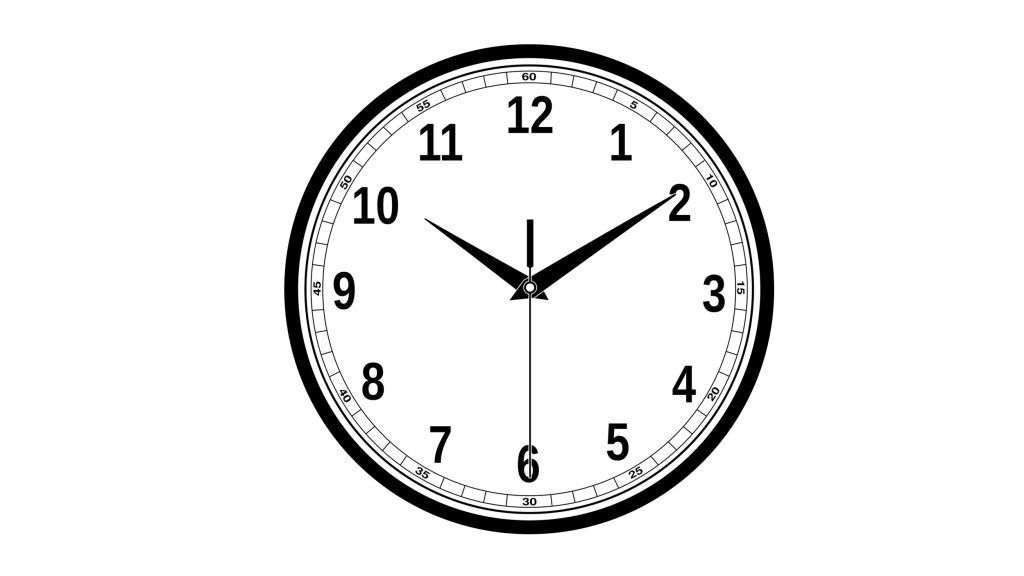
Developing the ability to read an analogue timepiece remains a fundamental cognitive skill that bridges mathematical understanding with daily time management. This comprehensive guide provides a structured eight-step methodology for educators and parents to teach children how to interpret the circular interface of a traditional clock.
By breaking down the complexities of the hour hand, minute hand, and the sixty-second cycle, the article ensures that learners move from basic orientation to precise timekeeping. Readers will discover practical strategies for identifying intervals, understanding the relationship between numbers and five-minute increments, and mastering the concept of “past” and “to”.
This resource is distinct in its use of incremental skill-building, specifically designed to reduce learner anxiety while fostering a permanent grasp of temporal measurement.
Key Takeaways
- Sequential instruction ensures learners master basic clock orientation before attempting complex minute calculations.
- Identifying the distinct functions of the hour and minute hands prevents common reading errors.
- Visualising the clock face as a series of five-minute intervals simplifies the conversion of numerical markers.
- Regular verbalisation of time using traditional terminology builds confidence and practical application skills.
- Consistent practice with physical analogue tools reinforces the relationship between movement and elapsed time.
Telling time on an analogue clock can be challenging for many people since digital timepieces have grown so popular. The flat display of 60 strokes, 12 numbers, and 3 sticks that move mechanically all day can be somewhat baffling to some viewers.
A lot of children, teens and adults see it easier to tell the time using the digital clock on a phone, watch, microwave, radio, television, tablet or computer. So, why bother to learn to tell the time on an analogue clock? Well, there are several benefits of using an analogue clock.
Benefits of learning an analogue clock
An analogue clock
- helps children to understand subtraction as the difference between two numbers
- gives a person practise with multiple names for the same quantity e.g. 2:40 is the same as 20 to 3:00
- allows you to multiply using skip counting and saying the 2, 3, 4, 5, 6 and 12 times tables
- makes you learn clock arithmetic
- helps you understand modular arithmetic
- shows clearly time lapsed (how long was Mummy gone?) and time anticipated (how much longer until the exam is over?)
- teaches the concept of fractions e.g. quarter and half
Learn to tell time on an analogue clock with these 8 simple steps.
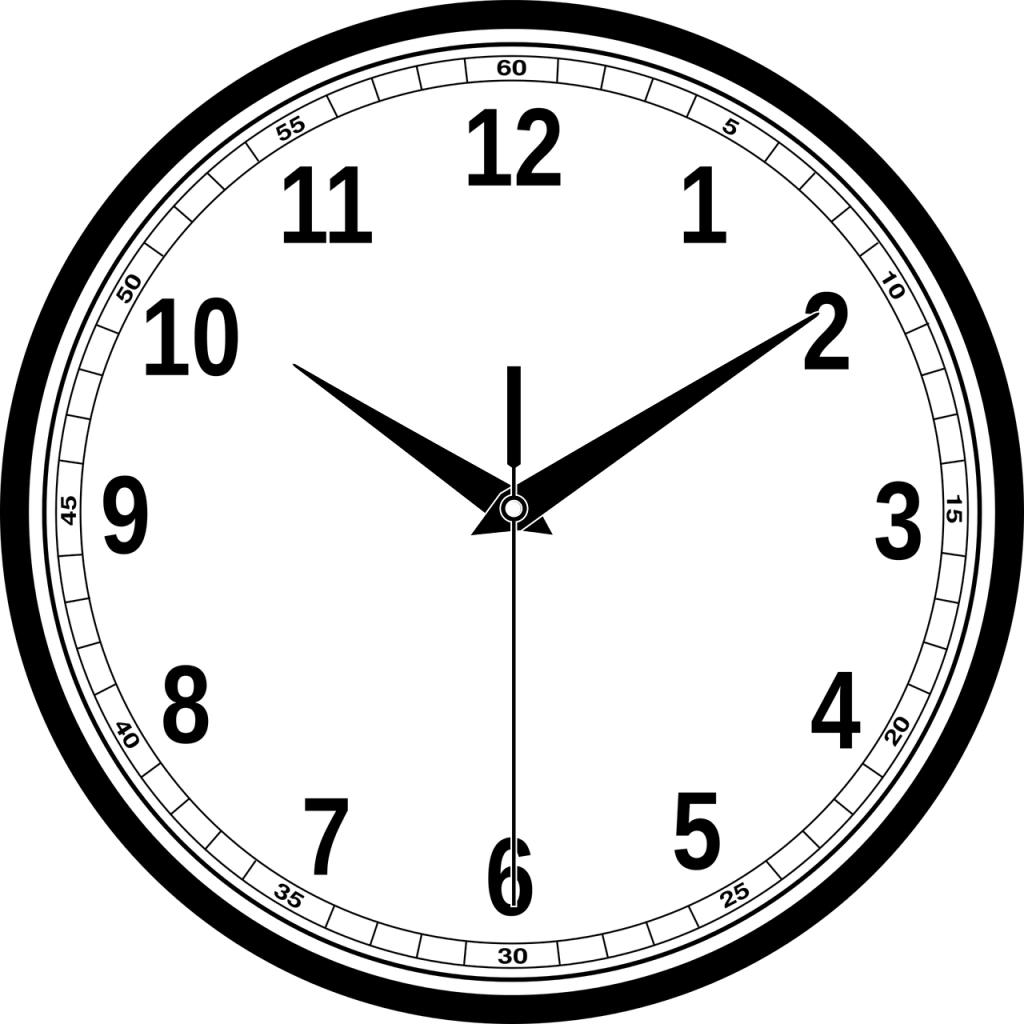
8 Steps to telling time on an analogue clock
Counting
Counting is a very important aspect of telling time on an analogue clock. There are 60 strokes on a clock. The big numbers on the clock are 1, 2, 3, 4, 5, 6, 7, 8, 9, 10, 11, 12.
You can count forward and backward to help you to understand time anticipated and time lapsed when reading an analogue clock. Use these counting worksheets to teach children to count numbers.
Five times tables
The 5 times tables or counting in fives is known to have a catchy ring to it. Clap your hands or tap your feet and chant 5, 10, 15, 20, 25, 30, 35, 40, 45, 50, 55, 60. Why is this important? Remember that a clock has 60 strokes and big numbers 1, 2, 3, 4, 5, 6, 7, 8, 9, 10, 11, 12?
Well, each big number represents 5 seconds. When you count the first 5 strokes, it is labelled number 1. When you count the next 5 strokes which reaches 10, it is labelled number 2. When you count the next 5 strokes which reaches 15, it is labelled number 15, and so on. Use this poster and worksheet to teach children 5 times tables.
Seconds, minutes, hours
Learn the meaning of seconds, minutes and hours to tell time on an analogue clock. There are:
- 60 seconds in 1 minute
- 60 minutes in 1 hour
- 24 hours in 1 day
On a clock, each stroke represents 1 second. There are 60 strokes around the clock which represent 60 seconds. After you count all 60 seconds, it is the same as saying 1 minute.
When you count 1 minute 60 times, it is the same as saying 1 hour. The numbers 1, 2, 3, 4, 5, 6, 7, 8, 9, 10, 11, 12 each represents an hour.
Circle
The shape of an analogue clock is circle. Even if the outer frame is a square, triangle or rectangle, the face of the clock inside the frame is still a circle. The 60 strokes make a complete circle with the number 12 at the top, 6 at the bottom, 9 at the left, 3 at the right, and all the other numbers in between.
This circle shape allows you to clearly see how the time circles appropriately in two rounds of 12 hours each in a day. Use these worksheets to have fun with circles.
O’clock, quarter and half
Learning about o’clock is pretty straightforward. Each of the 12 big numbers represents o’clock after counting 60 minutes. Number 1 is 1 o’clock just like 1:00 on a digital clock; 2 is 2 o’clock or 2:00, 3 is 3 o’clock and so on.
To understand quarter and half, you must learn fractions. Draw a circle. At the centre from top to bottom, draw a vertical line. Numbers 12 at top and 6 at bottom mark half of the circle. At the centre from left to right, cross this line with a horizontal line. Number 3 at left and 9 at right mark quarter.
Face and hands
So far, the strokes and numbers are all displayed on the face of a clock, and the hands are the sticks that rotate from the centre point. There are 3 hands on a clock:
- Second hand is the fastest
- Minute hand is the longest
- Hour hand is the shortest
When the second hand ticks around the clock 60 times, the minute hand moves once onto the next stroke. When the minute hand moves around the clock 60 times and hits the number 12, the hour hand moves to the next big number. This means that when the short hand is on 1 and the long hand is on 12, it’s 1 o’clock or 1:00.
Minutes past and to the hour
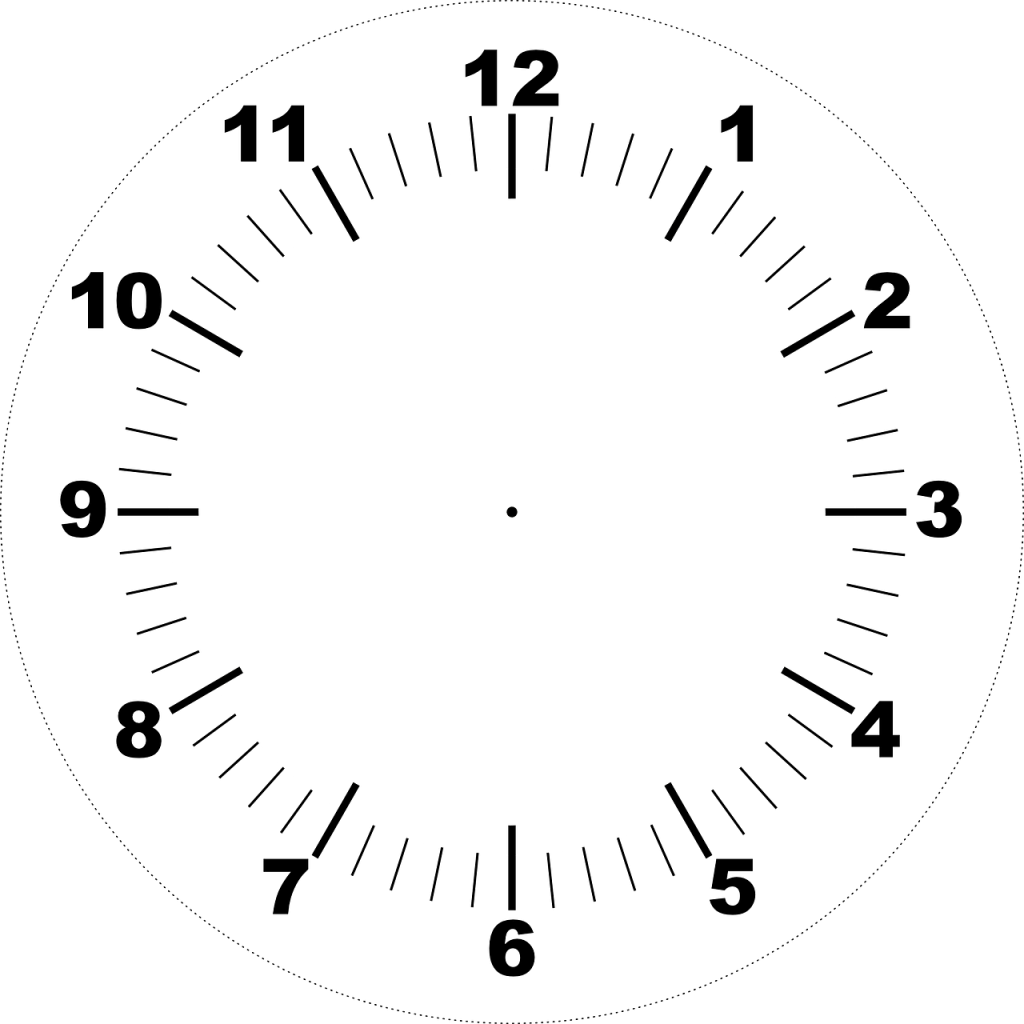
Remember the line that was drawn vertically down the centre of the circle? Well, the right side of that line is called ‘past’ and the left side is called ‘to’.
This means that when the minute hand aka the long hand is on the right side of that line, you say that the time is minutes past the hour e.g. 5:20 is the same as saying 20 minutes past 5 o’clock.
When the minute hand is on the left side of that line, you say that the time is minutes to the next hour e.g. 5:40 is the same as saying 20 minutes to 6 o’clock.
AM and PM
While a digital clock tells you whether it is 8 o’clock in the morning (AM) or 8 o’clock in the night (PM), an analogue does not. You still need to look outside to see what time of the day is it.
AM starts at 12 o’clock in the morning when it is dark and ends at 11.59 in the morning, which is one second before noon or lunch time. PM starts at 12 o’clock noon and ends at 11.59 in the night.
Eight steps to telling time on an analogue timepiece
Telling time is a milestone in primary education that requires a blend of spatial awareness and arithmetic. While digital displays offer immediate answers, the analogue clock provides a visual representation of the passing day, helping students understand the duration and the cyclical nature of time.
Understand the clock face anatomy
The first step involves familiarising the learner with the static elements of the timepiece. An analogue clock consists of a circular face typically numbered from 1 to 12. These numbers represent both hours and five-minute intervals. Understanding that the 12 is at the top center provides a necessary point of orientation for all subsequent steps.
Differentiate between the hands
Learners must distinguish the short hand (hour hand) from the long hand (minute hand). The hour hand moves slowly, indicating the current hour, while the minute hand travels faster to show the progression through sixty minutes. Many educational clocks use colour coding, such as red for hours and blue for minutes, to reinforce this distinction during the early stages of learning.
Mastering the hours
Before introducing minutes, focus entirely on the hour hand. When the long minute hand points directly at the 12, it is an “o’clock” time. Practice identifying 1:00, 2:00, and so on. This establishes the foundation of the twelve-hour cycle before adding the complexity of fractional parts of the hour.
Introduce the five-minute intervals
Each number on the clock face represents five minutes. Teach children to skip-count by fives as they point to each number: 1 is five past, 2 is ten past, and so on. This step links basic multiplication or addition skills directly to the clock face, allowing the learner to see the 12 numbers as 60 individual minutes.
Understand the half-hour and quarter-hour
Visualising the clock as a pie helps in understanding “half past” (the 6), “quarter past” (the 3), and “quarter to” (the 9). Breaking the circle into four quadrants provides a geometric perspective on time, making it easier to grasp why 30 minutes is considered half an hour.
The concepts of “past” and “to”
The clock is divided vertically. The right side (minutes 1 through 30) uses the term “past,” while the left side (minutes 31 through 59) often uses the term “to.” For example, 4:40 is frequently expressed as “twenty to five.” Mastering this linguistic shift is essential for fluid communication of time in British English.
Tracking the second hand
While not always the primary focus, the thin, rapidly moving second hand illustrates the smallest unit of time on the face. One full rotation of the second hand equals one minute. Observing this movement helps children internalise the speed at which time passes.
Practice and real-world application
The final step is consistent immersion. Ask the learner to check the time during daily transitions, such as meal times or before leaving for school. Using a physical clock where the hands can be manipulated manually allows for tactile learning, which often settles the concepts more firmly than passive observation.
See also: