
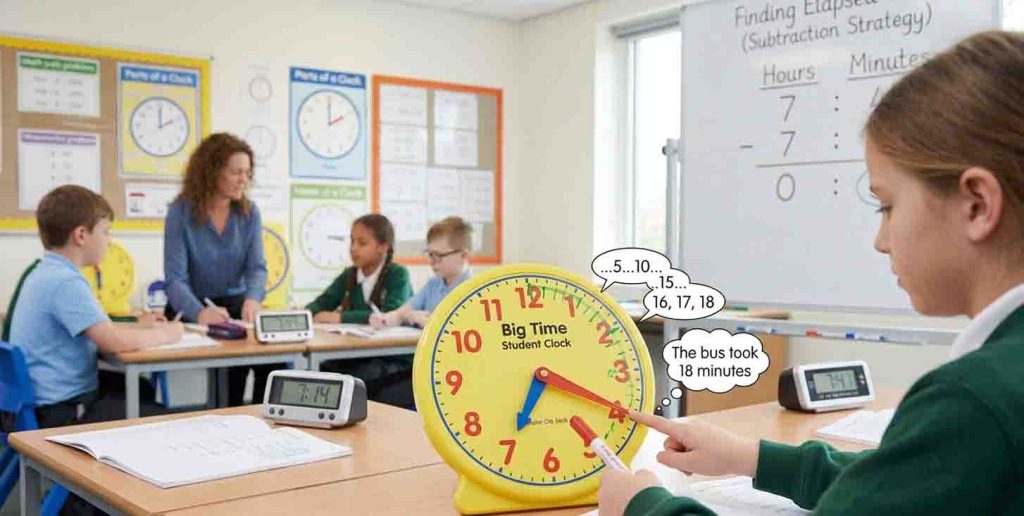
Understanding elapsed time is a foundational mathematical skill that requires young learners to measure the duration between a specific start time and an end time. This comprehensive guide provides primary school teachers, intervention specialists and parents with targeted instructional strategies to help children 7 years and older and remedial learners master time intervals.
Many children easily grasp reading digital or analogue clocks but experience a significant cognitive block when calculating the passage of hours and minutes. This article examines the underlying reasons for this common learning barrier, offers structured pedagogical solutions for neurodivergent or delayed learners, and delivers three distinct practical methods for calculation.
Readers will discover how to diagnose specific gaps in student comprehension, integrate multi-sensory tools into home and school routines, and maintain long-term retention through systematic review.
Key Takeaways
- Calculating elapsed time requires advanced spatial reasoning and a firm grasp of a non-decimal base sixty system.
- Primary students frequently fail to calculate duration because they mistakenly apply base ten subtraction rules to clock intervals.
- Multi-sensory instruction combining number lines, analogue clocks and tactile tools prevents struggling learners from falling behind.
- Consistent cooperation between parents and educators through daily at-home reinforcement ensures long-term retention of abstract mathematical concepts.
Why primary students struggle to understand elapsed time
Learning to tell the time involves a specific set of foundational skills that most primary school curricula introduce at an early age. Children memorise the components of the clock face, identifying the short hour hand, the long minute hand, and the rapidly moving second hand.
They practise counting by fives to navigate the twelve numbers on the dial, and they master terminology such as o clock, half past, quarter past, and quarter to. For many educators and parents, a child who can look at a clock dial and confidently state that the time is twenty minutes past four appears to have mastered the topic.
The difficulty arises when the instructional focus shifts from reading a static display to calculating duration. A nine-year-old student who functions perfectly well in general mathematics may become entirely lost when asked to determine how much time passed between leaving home at two o clock and returning at four o clock. The same child might look blankly at a test question asking for the duration of a bus journey that began at seven o clock and passed a local park at eighteen minutes past seven.
The primary reason for this difficulty is that elapsed time requires a transition from static identification to abstract spatial and sequential reasoning. When a child learns general addition or subtraction, they operate within the base ten numbering system, where regrouping occurs in predictable multiples of ten, one hundred, and one thousand.
The measurement of time operates on a base sixty system, known as a sexagesimal system. When a student attempts to calculate the difference between ten minutes past seven and forty-seven minutes past seven, they must manipulate intervals that do not align with the standard decimal rules they use for regular arithmetic.
Another barrier is the abstract nature of time itself. A piece of fruit or a set of plastic blocks can be divided physically to demonstrate fractions or basic subtraction. Time cannot be held, anchored, or visually frozen.
For a child with an executive functioning delay, dyslexia, or attention deficit hyperactivity disorder, tracking an invisible line of moments requires a high cognitive load. If the child has a minor gap in their understanding of the basic chronological sequence, the introduction of duration calculations causes them to hit a mathematical wall.
Because these students often perform excellently in other academic areas, their confusion remains hidden until formal assessments reveal they never truly understood the underlying framework of the clock.
The role of multi-sensory learning in remedial instruction
Traditional teaching methods in primary schools heavily rely on what is colloquially known as chalk and talk, where a teacher writes examples on a blackboard and explains the steps verbally. While this auditory and text-based approach succeeds for a large percentage of the classroom, it leaves behind a significant minority of normal, intelligent children who process information differently.
When a child fails to understand a topic after multiple verbal explanations, repeating the exact same words louder or slower does not resolve the issue. Instead, educators and parents must restructure the lesson using a combination of distinct learning styles.
Multi-sensory instruction integrates visual, auditory, kinesthetic, and read-write elements into a single learning experience. For a slow learner or an older student in an intervention class, using multiple pathways in the brain increases the likelihood of comprehension and memory retention.
Kinesthetic tools are especially effective for children who need a physical anchor for abstract concepts. Allowing a child to physically turn the gears of a demonstration analogue clock connects the muscular movement of their hands with the visual shift of the time indicators.
Visual tools such as brightly coloured posters, wall charts, and illustrated flashcards provide a permanent reference point in the learning environment. A student who struggles with short-term memory can glance at a wall poster to verify the meaning of quarter past without needing to interrupt their workflow to ask a teacher. Auditory learners benefit from rhythmic songs, instructional videos, and structured verbal skits that turn the rules of time into memorable patterns.
Because primary school teachers operate on rigid schedules dictated by national curricula, they rarely have the luxury of dedicating weeks of classroom time to a single concept. This reality makes parental involvement at home absolutely essential.
Parents can transform domestic routines into informal literacy and numeracy sessions. Simple conversations during a car ride or while cooking dinner reinforce the work done at school. Asking a child to look at the dashboard digital clock when leaving the supermarket and calculate the journey duration upon arriving home moves the mathematical concept from an abstract test sheet into real-world application.
Strategy one: The linear number line method
The linear number line method is one of the most effective strategies for students who struggle with the circular nature of a standard clock. A circular clock face can confuse children because the numbers reset after twelve, and the hands move in a continuous loop. Transforming this circular system into a straight, horizontal line allows the student to view time as a progressive sequence moving from left to right, matching the standard format of reading and basic addition.
To implement this strategy, the student draws a straight horizontal line on a sheet of paper. They label the far-left point with the specific start time of the event and the far-right point with the known end time. If the task is to calculate the time elapsed between ten minutes past seven and forty-seven minutes past seven, the left anchor is labelled 7:10 and the right anchor is labelled 7:47.
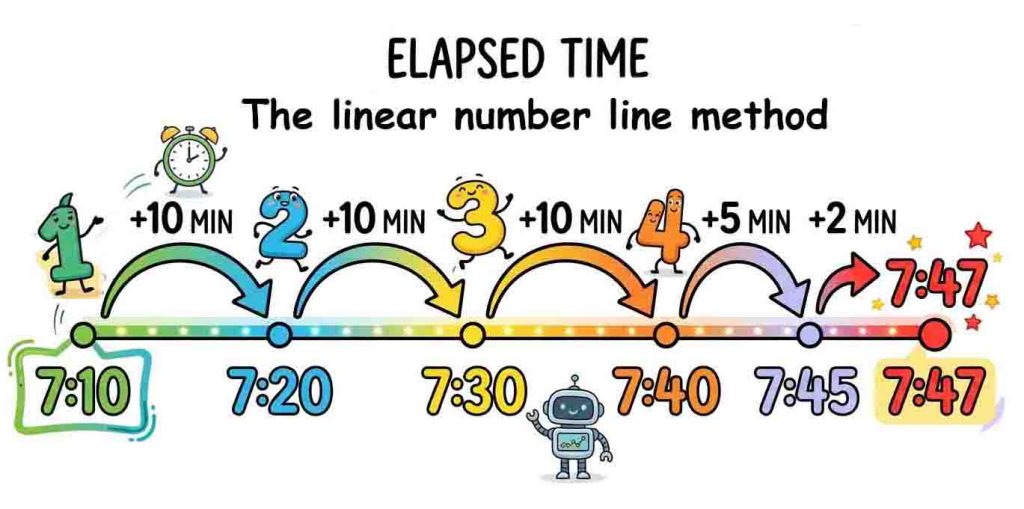
The student then uses a technique called skip counting to bridge the gap between the two milestones. They draw physical jumps or hills above the number line, labelling each jump with the number of minutes advanced. For a student requiring significant support, the teacher encourages them to skip count by tens, then by fives, and finally by ones.
From 7:10, the student draws a large jump representing ten minutes, landing at 7:20. They draw another ten-minute jump to reach 7:30, and a third ten-minute jump to reach 7:40. Recognising that they are approaching the end time of 7:47, they adjust their scale, drawing a smaller jump of five minutes to land at 7:45. Finally, they add two distinct single-minute jumps to arrive precisely at 7:47.
To determine the total elapsed time, the student gathers all the numbers written inside their hills or jumps and adds them together. In this scenario, the calculation is ten plus ten plus ten plus five plus two, resulting in a total of thirty-seven minutes. This visual representation allows the child to see the literal quantity of time expanded across the page, making the final sum a concrete reality rather than a guessed figure.
Strategy two: The analogue clock counting method
The analogue clock counting method directly utilises a physical or drawn clock dial to calculate duration. This method is highly suited for kinesthetic and visual learners who need to interact with the clock face to understand how minutes accumulate. For this strategy, a student needs an instructional clock with movable hands, or a laminated template where they can draw and erase marks with a dry-wipe marker.
When using this strategy to find the elapsed time, the student sets the physical clock hands to the initial start time. If the problem states that a bus journey began at seven o clock and concluded at eighteen minutes past seven, the student places the short hour hand pointing directly at the seven and the long minute hand pointing at the twelve, indicating 7:00.
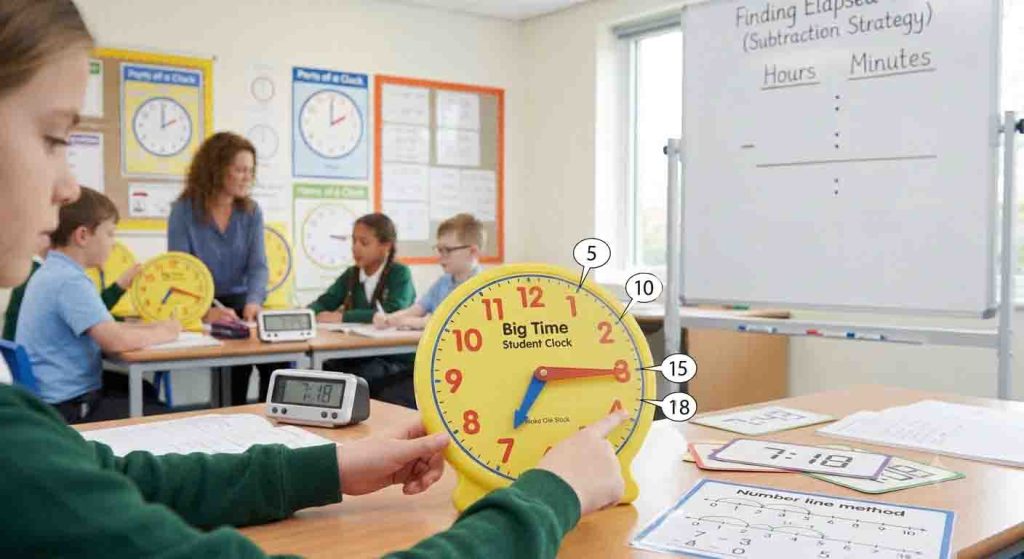
The student then tracks the movement of the minute hand toward the final position. Using the known numbers on the clock perimeter, the child points to each consecutive digit and counts aloud by fives. Starting at twelve, they move to the number one and say five, then to the number two and say ten, and then to the number three and say fifteen.
Because the end time is eighteen minutes past seven, the student stops counting by fives at the number three. They then shift to counting by single units for the remaining individual minute marks on the dial perimeter. Moving from the fifteen-minute mark, they touch each tiny line, counting sixteen, seventeen, and eighteen.
This method reinforces the physical distance travelled by the minute hand during the journey. The student can physically observe that eighteen minutes corresponds to a specific portion of the clock circle. For children who face difficulties with dyscalculia or general math anxiety, this tactile engagement replaces stressful mental calculations with a reliable physical routine.
Strategy three: The subtraction algorithm method
The subtraction algorithm method is the most abstract strategy, serving as an excellent progression for older primary students, adult literacy learners, or intervention students who have already mastered the number line and analogue clock models. This method translates the calculation into a standard column subtraction format, but it requires strict parameters to prevent the student from falling into the base ten trap.
To set up the calculation, the student must always write the end time on the top row and the start time on the bottom row. The columns must be neatly aligned, with hours positioned on the left side and minutes positioned on the right side, separated by a clear colon or vertical dividing line. If a task begins at two o clock and ends at four o clock, the student writes 4:00 directly above 2:00.
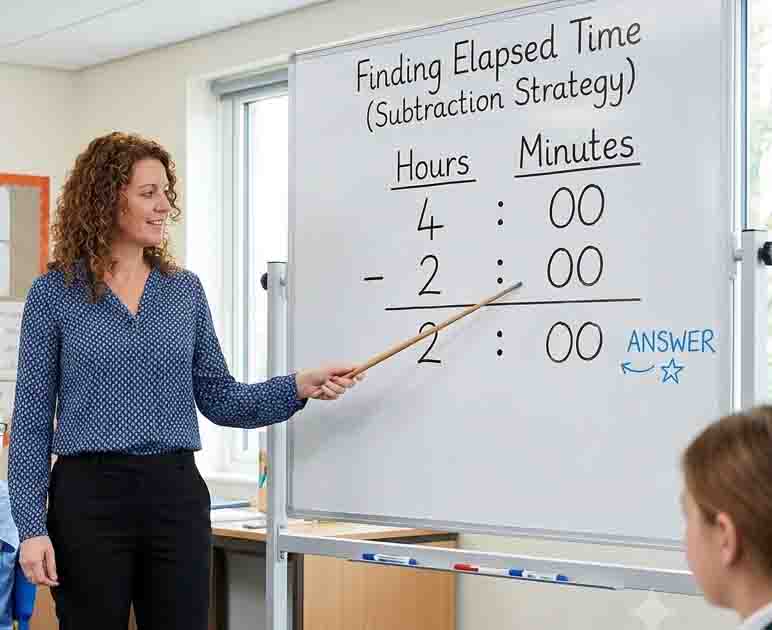
The calculation proceeds from right to left, starting with the minute column. In this simple example, zero minus zero equals zero. Moving to the hour column, four minus two equals two. The resulting figure indicates that the elapsed time is exactly two hours.
When minutes are more complex, such as starting a task at 7:10 and completing it at 7:47, the columns are arranged with 7:47 on the top and 7:10 on the bottom.
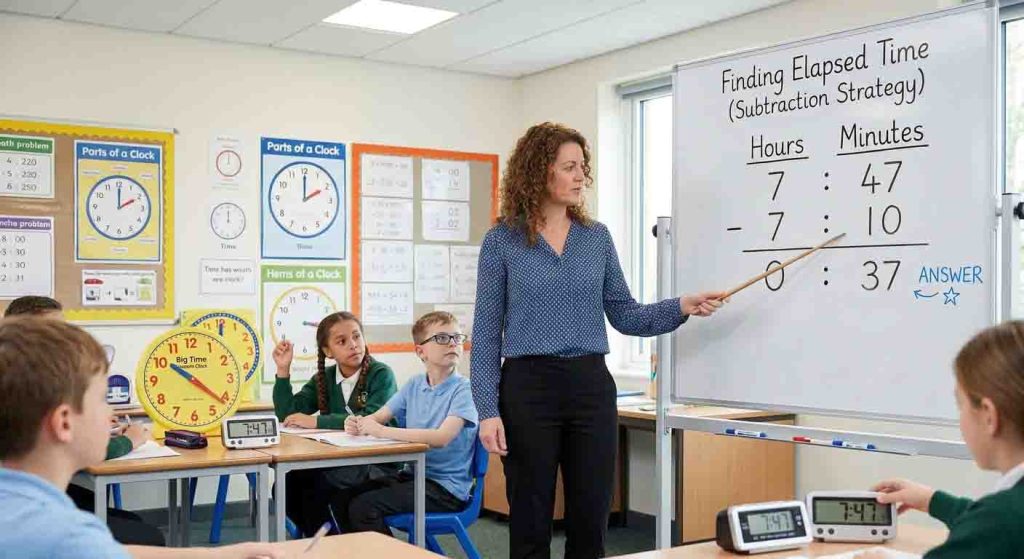
Subtracting ten minutes from forty-seven minutes yields thirty-seven minutes, while seven minus seven leaves zero hours. The elapsed time is determined to be thirty-seven minutes.
Teachers must exercise extreme caution when introducing examples that require regrouping across the hour barrier, such as calculating the time from 2:45 to 3:15. If a student tries to borrow a ten from the hour column as if it were a normal decimal number, they will arrive at an incorrect answer.
The educator must explicitly teach that borrowing one hour from the left column requires adding sixty minutes to the right column. Because of this complexity, the subtraction algorithm should only be introduced when a child can consistently explain why an hour contains sixty minutes rather than one hundred.
Long-term retention and environmental labelling
Introducing a strategy in a quiet intervention room is only the first step in helping a struggling learner. The true challenge is ensuring the child retains this knowledge weeks later when faced with a formal school examination or an unexpected real-world scenario. To move these concepts from short-term memory into long-term functional mastery, teachers and parents must implement a strategy of continuous exposure and environmental reinforcement.
Flashcards and posters are invaluable for imprinting essential terms and vocabulary onto a child’s mind. When a child sees the words elapsed time, duration, start time, and end time displayed on their bedroom wall or classroom noticeboard every single day, they develop automatic recognition. They no longer waste precious cognitive energy trying to remember what the word duration means during a test; instead, they immediately recognise the term and focus entirely on executing their preferred calculation strategy.
Educational videos and interactive games also provide low-stress opportunities for daily practice. Many digital platforms offer simulated clock activities where students can manipulate digital components to solve puzzles. These tools provide instant feedback, allowing a child to learn from an error privately without the fear of public failure in a crowded classroom.
Ultimately, consistency is the element that guarantees success. A child who spends five minutes every day calculating real intervals will achieve far greater stability than a child who undergoes a frantic three-hour study session the night before an exam. By pairing regular practice with a supportive, multi-sensory environment, parents and educators can ensure that no child slips through the cracks, transforming a confusing mathematical hurdle into a mastered, lifelong practical skill.
References
- Cockburn, A. D. (2007) Teaching Mathematics with Insight: The Challenges of Action-Research with Primary School Children. London: Routledge.
- Haylock, D. and Cockburn, A. D. (2013) Understanding Mathematics in the Lower Primary School. 4th edn. London: SAGE Publications.
- Hughes, M. (1986) Children and Number: Difficulties in Learning Mathematics. Oxford: Blackwell.
- Thompson, I. (ed.) (2010) Issues in Teaching Numeracy in Primary Schools. 2nd edn. Maidenhead: Open University Press.
See also:
How to teach blocks and place values to struggling primary school learners
Simplifying ascending and descending order: A practical guide for primary school intervention
How to add in 6 different ways: Fast facts and fun tricks to conquer calculations!
10 Real-world uses of algebra in everyday life
Algebra basics: 7 important things to know before you start
Clock: 8 Simple steps to telling time on an analogue timepiece
How variance is calculated for sample and population data? Explained with solution
The significance of Standard Deviation
4 Best calculus websites for students
@studyzoneinstituteltd