
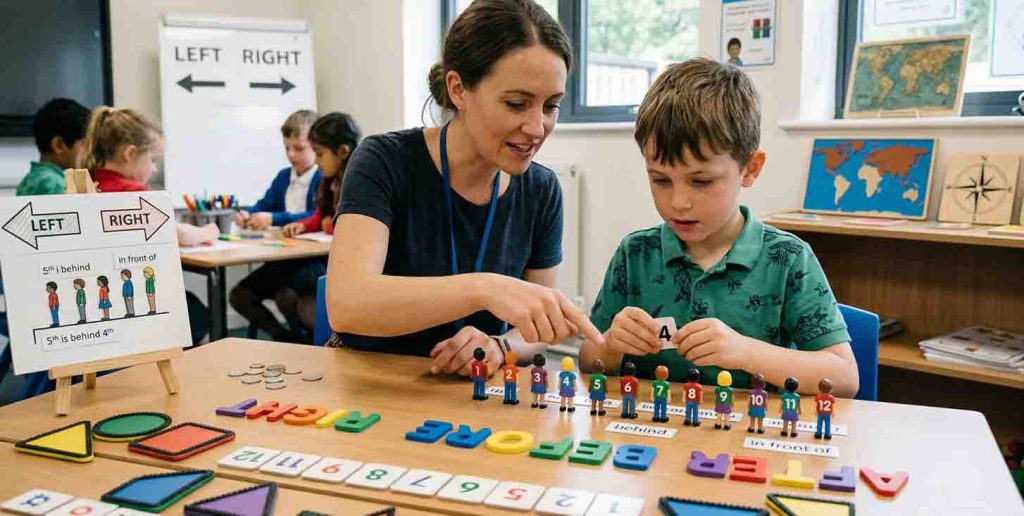
Many children aged six to ten years old across the globe are currently struggling to grasp fundamental spatial concepts, foundational vocabulary and simple mathematical logic. This widespread learning challenge affects everyday skills such as identifying left from right, calculating currency change and understanding sequence placement in basic word problems.
Educational research suggests that the combined effects of COVID-19 pandemic disruptions, early exposure to screens and the rise of short-form digital media have severely limited the concrete real-world experiences young learners need to build these cognitive foundations. This article examines the underlying root causes of this developmental gap and presents clear practical solutions for both home and classroom environments.
By shifting away from abstract textbook instruction toward age-appropriate multisensory techniques, parents and educators can rebuild essential cognitive frameworks. Adapting instructional strategies to meet current learner needs ensures that students gain the functional skills required for academic success and practical adult life.
Key Takeaways
- Many older children currently struggle with foundational spatial terms, mathematical sequencing and simple vocabulary equivalence.
- Extended screen exposure, short video formats and pandemic disruptions reduced the physical exploration required to build spatial logic.
- Assumptions about prior knowledge must be replaced with baseline diagnostic checks at all key learning stages.
- Multisensory instruction combining visual, auditory, kinesthetic and tactile methods bridges the gap between concrete facts and abstract thought.
- Practical real-world tools and interactive classroom activities restore functional problem-solving skills across primary and secondary education.
Understanding the growing cognitive gap in modern classrooms
Teachers and parents around the world are observing a baffling phenomenon in primary and secondary schools. Children aged six to ten years old, as well as many secondary school students, demonstrate normal intelligence and social behaviour yet fail to grasp foundational spatial concepts. Spatial terms such as before and after, behind and in front of, forward and backward, left and right, and less and more present immense hurdles.
This difficulty translates directly into mathematical logic problems. A student might understand that five is a larger number than four, yet fail to comprehend why being fourth in line puts a person in front of someone who is fifth in line. When presented with a simple word problem asking how many people are behind someone who is fourth in a line of twelve, these students often freeze or guess randomly.
The issue extends into daily functional literacy and practical numeracy. Children struggle with basic financial transactions, failing to determine how many one-dollar notes are needed to buy nine items priced at one dollar each.
In secondary school classrooms, teachers report that teenagers often lack basic vocabulary equivalence, failing to recognise that words such as buy, bought and purchase share the exact same definition. This gap between general intelligence and basic conceptual understanding poses a serious challenge to modern education.
Exploring the primary causes behind the conceptual deficit
To address this widespread learning challenge, educators must examine the environment in which today’s children have developed. Rather than assigning blame, analysing these environmental factors helps explain why traditional teaching methods are no longer yielding expected results.
The impact of COVID-19 lockdown interruptions
The global pandemic disrupted early childhood education at a critical developmental stage. Millions of children spent crucial early schooling months at home without access to structured group play, physical manipulation of classroom materials and guided spatial movement.
During these formative years, foundational concepts are usually reinforced naturally through playground navigation, line formation and tactile group activities. Missing out on these structured physical environments left significant gaps in spatial orientation and sequential logic.
Early screen exposure and reduced environmental exploration
A second major factor is the early introduction of digital screens into daily routines. When infants and young toddlers spend hours watching screens, they miss essential opportunities to explore physical space.
Natural cognitive development relies on observing cause and effect in the real world, such as stacking physical blocks, crawling under tables, reaching over chairs and judging distances. Staring at a flat, two-dimensional screen deprives the brain of essential three-dimensional spatial feedback, hindering the natural development of intuitive common sense.
Short-form video formats and shortened attention spans
The prevalence of short-form social media video content has further impacted how young minds process information. Short videos deliver rapid visual stimulus without requiring sustained focus, logical deduction or sequential reasoning. Consuming high volumes of fast-paced media makes it difficult for children to maintain the focus necessary to step through multi-stage word problems or follow complex multi-step instructions.
Moving from blame to action in home and school environments
Identifying the root causes of conceptual gaps is helpful for context, but dwelling on blame does not solve the immediate crisis. Children are growing up rapidly, and their inability to master early childhood concepts will eventually prevent them from becoming fully functional adults. Society depends on these students to become the skilled workforce, leaders and problem solvers of tomorrow.
Parents, guardians and educators must face the current reality without panic or frustration. Accepting this reality allows adults to replace ineffective, outdated instructional models with practical strategies that meet children where they are today.
Overcoming misleading assumptions in teaching
Traditional teaching often assumes that once a child reaches a certain age or grade level, they automatically possess foundational spatial and vocabulary skills. In the modern educational landscape, this assumption is no longer safe. Educators must eliminate assumptions regarding prior knowledge and integrate diagnostic assessments into every level of instruction.
Implementing multisensory techniques for functional learning
The most effective way to restore spatial logic, mathematical reasoning and language equivalence is through multisensory learning strategies. Combining visual, auditory, read-write and kinesthetic pathways creates multiple neural connections, making abstract ideas tangible and intuitive.
Using real-life tools for primary math concepts
Teaching abstract mathematical concepts to six-to-ten-year-old children requires physical representation. Classrooms should feature age-appropriate real-world tools rather than relying solely on worksheets or chalkboards.
When teaching currency, financial equivalence and making change, classrooms and homes should use play money and realistic shopping dramatisations. Setting up a mock store where children physically exchange dollar bills for goods helps bridge the gap between abstract numbers and practical value.
When introducing geometry and spatial properties, students should handle actual physical shapes. Counting the edges, corners and faces of tangible wooden blocks or everyday household objects instils an intuitive grasp of geometry that static textbook diagrams cannot match.
Concrete learning strategies for secondary students
Multisensory instruction is not limited to early childhood education. Teenagers who struggle with vocabulary or algebraic spatial relationships also benefit from concrete, hands-on learning models. High school teachers must adapt traditional lecture formats to include interactive visual representations and practical demonstrations.
For language arts, vocabulary equivalence can be taught using visual mapping techniques. Displaying words like buy, bought and purchase together on physical cards alongside context scenarios helps secondary students form lasting connections between related terms.
For mathematical line problems, having students physically stand up and form a line in the classroom provides immediate visual and spatial clarity. Demonstrating that the fourth person in line has eight people standing behind them in a group of twelve turns a confusing abstract puzzle into an obvious physical reality.
Rebuilding foundational concepts for long-term success
Addressing spatial and conceptual learning gaps requires consistent effort across both home and school environments. By taking systematic steps today, adults can ensure that children develop the critical thinking skills needed for future academic and professional endeavours.
Conclusion
The widespread cognitive and spatial gaps observed in today’s young learners present a serious challenge, but one that is entirely solvable. By understanding the combined impact of pandemic disruptions, screen usage and modern media habits, parents and educators can move past frustration and embrace practical solutions.
Replacing outdated abstract instruction with multisensory, hands-on learning techniques allows students of all ages to master basic concepts effectively. Investing in these targeted strategies today ensures that children build the spatial, mathematical and linguistic foundation needed to navigate the modern world successfully.
Sources
Educational Psychology Review
- The Impact of Multisensory Learning Strategies on Spatial Cognition and Numeracy Skills
- https://www.tandfonline.com/doi/full/10.1080/10494820.2024.2427277
Journal of Child Development
- Screen Time Exposure and Early Childhood Spatial Awareness
- https://www.researchgate.net/publication/400012641_Screen-Time_Exposure_and_Behavioral_Problems_in_Early_Childhood_A_Cross-Sectional_Survey_of_School_Children
International Journal of Educational Research
- Post-Pandemic Learning Gaps in Primary and Secondary Education
- https://www.mdpi.com/2227-7102/12/5/315
See also:
Teaching coins and notes: A comprehensive guide for lower primary success
Understanding time on digital and analogue clocks for learners who struggle
Teaching buying and selling to primary learners
Understanding ordinal numbers and positional words for early learners
Ordering more and less explained: Overcoming math word problem confusion
Master elapsed time with three practical methods for parents and teachers
How to teach blocks and place values to struggling primary school learners
Simplifying ascending and descending order: A practical guide for primary school intervention
How to add in 6 different ways: Fast facts and fun tricks to conquer calculations!
10 Real-world uses of algebra in everyday life
Algebra basics: 7 important things to know before you start
Clock: 8 Simple steps to telling time on an analogue timepiece
How variance is calculated for sample and population data? Explained with solution
The significance of Standard Deviation
4 Best calculus websites for students
@studyzoneinstituteltd