
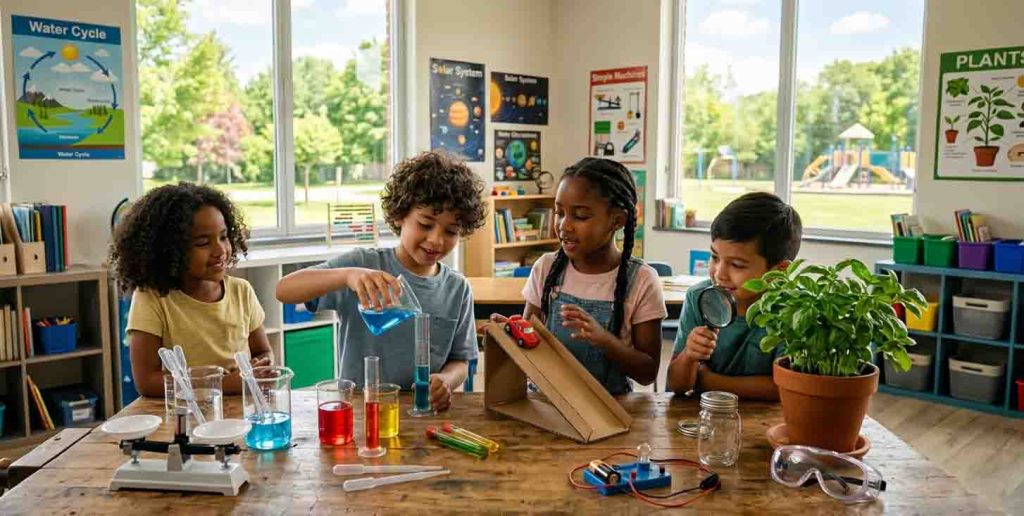
Science projects for elementary students provide a structured, engaging and highly effective way to build curiosity, critical thinking and foundational scientific literacy in early learners. These projects transform abstract scientific principles into tangible experiences that young students can observe, test and understand through active participation.
In modern classrooms, where experiential learning is increasingly prioritised, hands-on science activities have become essential tools for teachers seeking deeper engagement and measurable comprehension. This article explores practical, classroom-tested approaches that align with curriculum standards while fostering creativity, inquiry and problem-solving skills.
The relevance of science education at the elementary level has increased significantly due to global emphasis on STEM development. Teachers are now expected to deliver content that is not only accurate but also interactive and accessible to diverse learners.
Hands-on science projects bridge this gap by allowing students to experiment with real-world phenomena using simple materials. This article presents structured insights into how these projects can be designed, implemented and adapted across different age groups and learning environments.
By focusing on safety, accessibility and scientific integrity, educators can transform everyday classroom experiences into meaningful scientific discovery. The approaches discussed here are grounded in established pedagogical frameworks such as inquiry-based learning and constructivist theory, ensuring both academic relevance and practical application.
Key Takeaways
- Hands-on science builds stronger conceptual understanding in young learners.
- Simple materials can effectively demonstrate complex scientific principles.
- Inquiry-based learning increases student engagement and retention.
- Teachers can align experiments with curriculum goals without added complexity.
The educational power of hands-on science in early learning
Science education at the elementary level is most effective when it moves beyond memorisation into exploration. Young learners are naturally curious, and structured experimentation allows that curiosity to develop into disciplined inquiry. Hands-on science projects create a learning environment where students are not passive recipients of information but active participants in discovery.
Cognitive development research consistently shows that children in early education stages learn best through sensory engagement. When students mix substances, observe reactions or build simple models, they are forming neural connections that strengthen memory and understanding. This process aligns closely with Jean Piaget’s constructivist theory, which emphasises learning through experience and interaction with the environment.
Teachers benefit from this approach because it reduces abstract teaching challenges. Instead of explaining theoretical concepts in isolation, they can demonstrate principles such as density, buoyancy or energy transfer in real time. This not only improves comprehension but also reduces classroom disengagement.
Designing effective science projects for elementary classrooms
Creating effective science projects for elementary students requires careful balance between simplicity and scientific accuracy. The goal is not to overwhelm students with complex terminology but to introduce foundational concepts in a way that is both engaging and age-appropriate.
A well-designed project begins with a clear scientific question. For example, rather than stating a concept directly, a teacher might ask why some objects float while others sink. This framing encourages prediction and hypothesis formation, which are key elements of scientific thinking.
Materials should remain accessible and inexpensive. Everyday household items such as vinegar, baking soda, paper, water, plastic bottles and food colouring can be used to demonstrate a wide range of scientific principles. This ensures that projects are replicable both in school and at home, reinforcing learning through repetition.
Safety remains a core consideration. Even simple experiments should include supervision guidelines and clear instructions. Elementary students must be taught early that scientific exploration requires responsibility and care.

Exploring physical science through simple experiments
Physical science concepts are particularly well suited to hands-on learning because they involve observable forces and reactions. One of the most effective approaches is exploring motion and energy through simple classroom demonstrations.
When students construct basic ramps using books and cardboard, they can investigate how slope affects speed. By rolling objects of different weights down the ramp, they begin to understand friction, gravity and inertia in a practical context. These observations form the basis for more advanced physics concepts in later education.
Electricity can also be introduced safely using simple battery-powered circuits. Students can connect wires, bulbs and batteries to observe how electrical energy flows. This builds foundational knowledge about conductivity and circuit design without requiring complex equipment.
These physical science experiments reinforce the idea that scientific principles govern everyday life. Students begin to recognise that the world around them operates according to predictable laws that can be tested and understood.
Life science projects that encourage observation and empathy
Life science projects are particularly effective in developing observational skills and environmental awareness. Elementary students are naturally drawn to living systems, making this area of science highly engaging.
One common classroom approach involves observing plant growth under different conditions. Students can plant seeds in separate containers and vary factors such as light, water or soil type. Over time, they record changes and compare results. This teaches not only biology but also data collection and analysis.
Another effective project involves studying ecosystems. Even a simple terrarium can demonstrate how organisms interact within a controlled environment. Students observe moisture cycles, plant development and decomposition processes, gaining insight into ecological balance.
Life science projects also encourage empathy towards living organisms. When students care for plants or small ecosystems, they develop a sense of responsibility and environmental stewardship. This emotional connection enhances learning and supports long-term retention of scientific concepts.

Chemistry experiments that spark curiosity
Chemistry is often perceived as complex, but elementary-level experiments can make it accessible and exciting. Safe chemical reactions using common household materials provide vivid demonstrations of scientific principles.
A widely used classroom experiment involves combining baking soda and vinegar. This reaction produces carbon dioxide gas, which can inflate balloons or create visible bubbling effects. Students observe how substances change when they interact, introducing them to the concept of chemical reactions.
Food colouring diffusion in water is another effective demonstration. By adding drops of colour into still and warm water, students can observe how temperature affects molecular movement. This introduces foundational concepts related to particle theory.
These experiments are particularly powerful because they produce immediate visual results. Young learners benefit from direct cause-and-effect relationships, which strengthen understanding and retention.
Integrating mathematics and data collection in science projects
Science education is closely linked with mathematics, particularly in areas such as measurement, comparison and data interpretation. Elementary science projects provide an ideal platform for integrating these disciplines.
Students can measure plant growth over time, record temperature changes or track the speed of moving objects. These observations are then organised into simple charts or graphs. This introduces the concept of data representation in a practical and meaningful way.
Mathematical integration helps students understand that science is not isolated from other subjects. Instead, it forms part of a broader analytical framework used to interpret the world. This interdisciplinary approach strengthens both numerical literacy and scientific reasoning.
Teachers benefit from this integration because it reinforces multiple curriculum objectives within a single activity, making classroom instruction more efficient and cohesive.

Encouraging inquiry-based learning in elementary science
Inquiry-based learning is a central principle in modern science education. Rather than providing answers directly, teachers guide students through the process of discovery. This method is particularly effective for Science Projects for Elementary Students because it aligns with natural curiosity.
Students are encouraged to ask questions, form hypotheses and test their ideas through experimentation. This process develops critical thinking skills and fosters independence in learning. It also helps students understand that failure is part of scientific exploration, not a setback.
Teachers act as facilitators rather than lecturers. They provide structure, ensure safety and guide reflection, but allow students to take ownership of their learning. This shift in role enhances engagement and encourages deeper cognitive processing.
Building long-term scientific interest through classroom projects
One of the most important outcomes of hands-on science education is the development of long-term interest in scientific fields. Early exposure to experimental learning increases the likelihood of students pursuing STEM subjects in later education.
When students experience the satisfaction of discovering how something works, they develop intrinsic motivation. This is more powerful than external rewards because it is rooted in curiosity and personal achievement.
Teachers play a critical role in shaping this mindset. By consistently providing meaningful and enjoyable science experiences, they help students associate science with discovery rather than difficulty. Over time, this builds confidence and encourages continued exploration.

The role of teachers in facilitating scientific discovery
Teachers are central to the success of any hands-on science programme. Their ability to design, guide and adapt experiments determines the effectiveness of the learning experience. In elementary education, this role is particularly important because students rely heavily on structured guidance.
Effective science teachers balance instruction with exploration. They introduce concepts clearly, demonstrate procedures and then allow students to engage actively with the material. This balance ensures both understanding and independence.
Professional development in science education can further enhance teacher confidence. Familiarity with basic scientific principles and experimental design allows educators to create more dynamic and responsive classrooms.
Transforming classrooms through experiential science
Hands-on learning represents one of the most effective approaches to teaching science at the elementary level. By engaging students directly with experiments, observations and real-world applications, educators can transform abstract concepts into meaningful understanding.
Science projects for elementary students are not merely classroom activities; they are foundational experiences that shape how young learners perceive and interact with the world. When designed thoughtfully, these projects cultivate curiosity, reinforce academic skills and build a lasting appreciation for scientific inquiry.
As education systems continue to evolve, the importance of experiential learning will only grow. Teachers who embrace hands-on science are not only improving academic outcomes but also nurturing the next generation of critical thinkers, innovators and problem-solvers.
When you buy something through our retail links, we may earn commission and the retailer may receive certain auditable data for accounting purposes.
- How do debits and credits work? A beginner’s guide to accounting
- Mastering subject verb agreement: Interactive teaching strategies for diverse learners
- Game world and real world: Helping children appreciate life and build genuine social connections
- Why older children struggle with basic spatial concepts and how multisensory learning can fix it
- Master homophones and homographs: Easy strategies for struggling learners
See also:
The periodic table made simple: Learn chemistry basics with interesting techniques
Teach science without a lab: Fun at-home activities that spark curiosity
Become a science teacher: A rewarding career path
Veterinary medicine: A rewarding career for animal lovers
Science resources: Ignite student curiosity with engaging tools
What is good health? Boost your brain and body with these tips
Electricity: Unravelling the fundamentals
Friction: The imperceptible force paving our path
Gravity: A universal force that affects every aspect of our lives
Exploring electricity and magnetism: Unveiling the power behind your gadgets
Exploring life’s diversity: A look at major groups of organisms
Physics: Examples of complex theories and equations in everyday life
Chemistry fundamentals: Exploring matter, particles, and changing states
Major groups of organisms in over 8 million types
7 Characteristics of living things
@studyzoneinstituteltd