
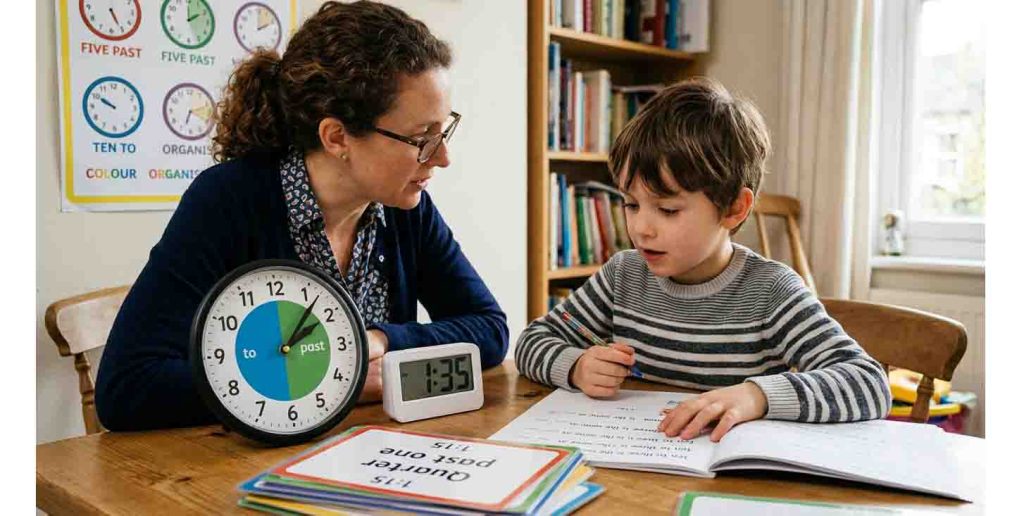
Teaching students to read time on digital and analogue clocks is a fundamental primary milestone that often presents hidden challenges for various learners. While many children effortlessly grasp how 1:15 equates to quarter past one, a significant number of normal, intelligent students encounter a conceptual wall when translating these figures during assessments.
This comprehensive guide analyses the underlying cognitive barriers that prevent children from linking digital numerals to analogue clock faces, especially when questions require filling in blanks.
It provides practical, multi-sensory teaching strategies that combine visual, auditory, and kinesthetic methods to ensure remedial students, dyslexic learners, and individuals with attention differences achieve permanent mastery.
Key Takeaways
- Learning to read analogue and digital clocks requires complex spatial awareness and linguistic translation skills that frequently cause unacknowledged difficulties for young students.
- Traditional rote learning fails when vulnerable learners cannot bridge the conceptual gap between numerical displays and the circular geometry of traditional clock faces.
- Consistent home intervention utilising flashcards, educational games, and multi-sensory tools prevents struggling students from falling behind in fast-paced school environments.
The hidden challenge of telling time
Learning to tell the time is a standard benchmark in early primary education. For the majority of children aged seven and older, the transition between an analogue clock face and a digital display occurs naturally.
Average students can look at a list of times and quickly understand that 1:00 is one o’clock, 1:15 is quarter past one, and 1:45 is quarter to two. They memorise the intervals of five, grasp the linguistic patterns, and successfully apply this knowledge to standard school worksheets.
However, there is a large group of students who experience immense difficulty with this topic. These children are normal, capable, and often excel in other school subjects. They can copy notes from the whiteboard perfectly.
They can read the sentence “five past one is the same as 1:05” and repeat it aloud. Yet, the moment they face an independent test question that asks them to fill in a blank, such as “twenty to two is the same as ___:___”, their understanding collapses.
This delayed comprehension often slips through the cracks of a busy classroom. Because these children do not exhibit obvious behavioural issues or general learning delays, their specific struggle with time remains unnoticed.
Teachers and parents are frequently blindsided when a nine-year-old or ten-year-old student hits a mathematical wall, only for adults to discover that the child never understood the preschool and lower primary basics of time keeping. The discovery causes severe frustration for parents and educators who find it difficult to pinpoint exactly where the learning process broke down.
Understanding time requires a student to decode symbols, calculate fractions, and navigate a base-sixty mathematical system all at once. When a child performs excellently in reading or science but fails repeatedly at telling time, it is not a sign of defiance or laziness. It indicates a specific cognitive disconnect that requires a specialised, multi-sensory teaching approach.
Why students struggle with clock formats
To help a student who is falling behind, one must first understand what causes this specific learning shortage. An analogue clock is a complex spatial tool. Unlike a standard number line that runs from left to right in a straight path, an analogue clock is circular.
It requires spatial processing to understand that the number one represents five minutes, the number two represents ten minutes, and the number six represents thirty minutes. For a child with subtle learning differences, such as dyslexia or dyscalculia, this dual identity of numbers is highly confusing. The brain must constantly translate the physical position of a hand into a completely different numerical value.
The second major hurdle is the linguistic shift that happens when the clock hand passes the half-hour mark. From 1:00 to 1:30, the language moves forward, using the phrase “past”. A child learns that 1:10 is ten past one. However, the moment the minute hand moves past the six, the linguistic framework changes entirely. The time 1:35 becomes twenty-five to two.
This shift requires the student to do three things simultaneously. They must look at the digital hour hand which says “one”, ignore it, and mentally jump ahead to the next hour, which is “two”. Then they must calculate how many minutes are left until that next hour arrives.
For a student with Attention Deficit Hyperactivity Disorder or executive functioning challenges, this multi-step mental acrobatics is overwhelming. They look at the words “twenty to two” and write down 2:20 or 1:20 because their brains cannot process the backwards subtraction required for the “to” phrase.
Furthermore, traditional teaching methods rely heavily on the “chalk and talk” style. A teacher stands at the front of the room, holds up a plastic clock, demonstrates a few positions, and expects the children to transfer that visual data onto a flat piece of paper. For a remedial learner, that abstract leap is too wide.
If the student has a weak working memory, they cannot hold the rule for “past” and the rule for “to” in their minds at the same time. They read the phrase “quarter to nine” on a test, experience anxiety, and fill in the blanks at random. The issue is not that the child cannot read the words, but rather that they cannot map the words onto a functional mental model of a clock.
Multi-sensory strategies for teachers and parents
When a child shows signs of learning problems regarding time, repeating the same verbal explanations will not yield results. The teacher and parent must collaborate to present the topic using a combination of distinct learning styles.
This approach integrates visual, auditory, kinesthetic, and read-write learning tools. While it requires time and effort to prepare these resources, the positive outcomes are certain because consistency reshapes how the brain processes information.
Kinesthetic and tactile learning
Kinesthetic learning involves physical movement and touch. Instead of looking at a drawing of a clock, the student must build and interact with a physical model.
The Floor Clock
Create a large clock on the floor using a hula hoop or a giant circle cut from cardboard. Use large, brightly coloured paper numbers for the hours. Have the student physically stand in the centre of the circle. Give them two wooden sticks of different lengths to represent the hands of the clock.
When you say “half past six”, the child must physically place the short stick pointing toward the six and the long stick pointing toward the six. By using their entire body to navigate the clock face, the spatial layout becomes real rather than abstract.
The Two-Colour Clock Face
Modify a physical learning clock so that it is divided down the middle. Colour the right side, from twelve to six, in bright green to represent the “past” zone. Colour the left side, from six to twelve, in bright blue to represent the “to” zone.
This simple visual and tactile barrier gives the student an immediate reference point. If the minute hand is resting on the blue side, their brain receives an instant cue that they must use the word “to” and calculate the minutes remaining until the next hour.
Visual and auditory tools
Visual support helps fix abstract concepts into long-term memory. Since public and private schools operate on tight schedules, parents must reinforce these visual strategies at home.
Constant exposure via posters
Hang a large, clear poster of both an analogue clock and a digital clock in the bedroom or kitchen. The poster must clearly link the phrases to the numbers, showing side-by-side comparisons like 1:15 and quarter past one.
The human mind automatically records images that it sees constantly. Through passive daily exposure, the child will begin to recognise the shapes and words without feeling the pressure of a formal lesson.
Targeted flashcards
Create flashcards that isolate the problem areas. On one side, write the digital time, such as 1:40. On the reverse side, write the phrase “twenty to two”. Use these cards to play matching games.
Lay out five digital cards and five phrase cards face down, and have the student play a memory game to find the matching pairs. This repetitive practice removes the threat of test sheets and transforms learning into a game.
Auditory rhymes and skits
For auditory learners, information must be heard and spoken. Create simple, rhythmic chants to remember tricky transitions. Sing phrases like, “When the big hand is at nine, it is quarter to the time!”
Create short role-play scenarios where the child pretends to be an airport announcer stating flight times in both digital and analogue formats. Hearing their own voice use the vocabulary helps solidify the connection between the spoken word and the written number.
Helping students apply knowledge in tests
The true test of understanding is when a student can independently answer written questions. When faced with a fill-in-the-blank question, a struggling student needs a step-by-step system to prevent panic and errors. Teachers and parents should teach the student to use a three-step formula whenever they encounter time questions on a test paper.
First, teach the child to look at the word clue immediately. If the question reads “Ten to three is the same as ___:___”, the child should circle the word “to”. This tells them that the hour shown on the digital clock must be one hour behind the hour written in words. Because it says “to three”, the digital hour must be two.
Second, the student must calculate the minutes. They should know that the word “to” means subtracting from sixty. If it is ten to three, they count backwards by tens from sixty, landing on fifty.
Third, they write the final digits into the spaces, resulting in 2:50.
To make this automatic, the student must practice a high volume of these specific questions across multiple days. Regular practice prevents the student from forgetting the system when they move on to new mathematical topics.
Provide short, daily exercises containing just five fill-in-the-blank questions. Consistent exposure ensures that the child moves away from guessing and begins to rely on structured reasoning.
Long-term maintenance of the skill
Once a student has mastered the ability to convert analogue phrases into digital times, the education must not stop. Learners with dyslexia, ADHD, or general learning difficulties can easily lose a skill if it is not used regularly. To keep the knowledge fresh, integrate time-telling into daily life activities at home and school.
Replace digital appliances with analogue clocks in areas where the child spends time. When the child asks for a snack or wants to know when their favourite television show begins, avoid giving a direct digital answer. Instead, ask them to look at the wall clock and tell you how many minutes remain until the hour.
Utilise educational games on tablets that specifically focus on clock manipulation, ensuring that technology serves an instructional purpose.
By combining structured home reinforcement with multi-sensory teaching tools, parents and teachers can rescue a student from the frustration of hidden learning gaps.
Every child can master the clock when the teaching style matches their unique way of understanding the world. With patience, physical tools, and daily practice, the confusion of digital and analogue time will transform into a permanent, practical skill.
Conclusion
Mastering the conversion between digital and analogue clocks is a complex milestone that requires a sophisticated blend of spatial reasoning, mathematical calculation, and linguistic translation.
While conventional teaching methods leave many vulnerable primary students behind, a dedicated multi-sensory approach ensures that no child slips through the cracks. By blending tactile floor clocks and colour-coded faces with daily flashcards, targeted posters, and structured exam strategies, educators and parents can effectively demystify the abstract concepts of time.
Consistency remains the ultimate key to success for remedial learners, dyslexic students, and those with attention differences. When families take an active role at home to reinforce school lessons through interactive games and daily routines, the initial frustration of learning gaps quickly gives way to confidence.
Ultimately, transforming how time is taught does more than just prepare a student for an upcoming school test; it equips them with a vital, lifelong practical skill that builds a secure foundation for all future academic learning.
See also:
Teaching buying and selling to primary learners
Understanding ordinal numbers and positional words for early learners
Ordering more and less explained: Overcoming math word problem confusion
Master elapsed time with three practical methods for parents and teachers
How to teach blocks and place values to struggling primary school learners
Simplifying ascending and descending order: A practical guide for primary school intervention
How to add in 6 different ways: Fast facts and fun tricks to conquer calculations!
10 Real-world uses of algebra in everyday life
Algebra basics: 7 important things to know before you start
Clock: 8 Simple steps to telling time on an analogue timepiece
How variance is calculated for sample and population data? Explained with solution
The significance of Standard Deviation
4 Best calculus websites for students
@studyzoneinstituteltd