
This comprehensive classroom self-esteem exercise offers practical methods for primary school educators to help pupils aged seven years and older identify their personal strengths while addressing their academic and physical challenges.
Many young students struggle with low self-confidence due to social comparisons and academic pressure in subjects like mathematics, spelling, and grammar. This educational resource introduces two distinct strategies to facilitate self-reflection, catering to both quick classroom sessions and in-depth creative projects.
The guide provides structured instructions for teachers to support students of all physical abilities, ensuring healthy children recognise their physical fortunes while those with disabilities celebrate alternative strengths.
Educators can easily implement these frameworks to teach students that their positive traits and personal blessings always outweigh their temporary difficulties. This dual-method approach distinguishes itself by combining physical gratitude with growth mindset principles in a highly adaptable format for diverse classrooms.
Key Takeaways
- The classroom self-esteem exercise helps pupils balance their strengths and challenges.
- Pupils aged seven years and older evaluate academic skills alongside physical fortunes.
- Teachers can choose between a simple table or a three-dimensional scale project.
- The activity teaches students that their positive attributes outweigh temporary struggles.
Theoretical foundations of self-reflection in primary education
As children reach the age of seven years and older, they enter a significant developmental phase marked by increased self-awareness and social comparison. During this stage of childhood, pupils begin to evaluate their own performance against that of their peers. This shift can lead to vulnerability, especially when students encounter difficulties in core academic areas such as spelling, punctuation, grammar, or mathematics.
Without structured intervention, a child who experiences persistent frustration in these subjects can easily develop low self-esteem. This negative self-perception often overshadows their natural talents, such as playing a musical instrument, singing, or participating in athletic sports.
Furthermore, children seven years and older frequently take their physical health and functional abilities for granted. A pupil who runs effortlessly across the playground may feel entirely inadequate simply because they find Spanish vocabulary or scientific concepts difficult to master.
By implementing a formal classroom self-esteem exercise, educators can broaden the perspective of these students. This pedagogical process encourages children to take stock of their entire lives, helping them recognise that their physical fortunes and intrinsic talents are valuable assets. When pupils learn to look at their abilities holistically, they realise that their positive attributes outweigh their temporary academic struggles.
Implementing the classroom self-esteem exercise
To accommodate different classroom settings, time constraints, and resource availability, this reflective activity is designed in two formats. The first format is a direct, paper-based exercise utilising a simple two-column table, which is highly suited for regular lessons and quick assessments.
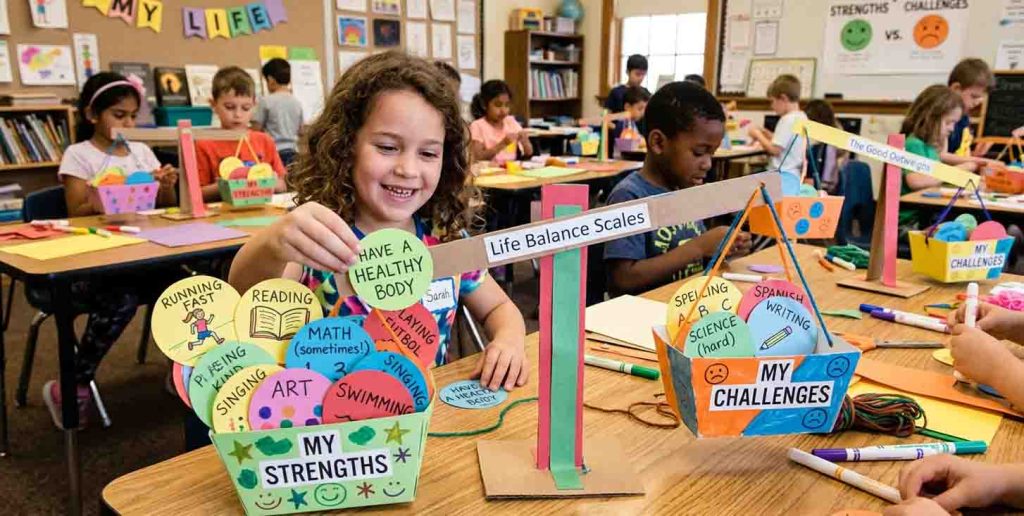
The second format is a three-dimensional paper balancing scale project, which is ideal for art-integrated lessons, interactive displays, and deeper kinesthetic learning. Both strategies guide pupils through the same developmental phases, ensuring that the underlying psychological benefits are preserved regardless of the chosen medium.
Whichever format an educator selects, the lesson must be introduced with clear guidelines regarding mutual respect. The teacher should explain to the class that every individual possesses a unique mixture of easy abilities and areas that require practise. By establishing a safe, non-judgmental environment, the educator ensures that students feel secure when identifying their challenges.
Strategy one: The two-column reflection table
The two-column reflection table is a highly effective, low-preparation strategy that allows pupils to organise their thoughts quickly. This approach is excellent for teachers who wish to fit the self-reflection exercise into a single class period. Pupils receive a worksheet containing a basic table with two headings. The teacher writes words or short phrases on the board from which students use to populate each column.
| Strengths | Challenges |
| Reading stories | Science |
| Playing football | Spanish |
| Singing | Mathematics |
| Building Lego | Spelling |
| Having a healthy body | Grammar |
| Being a kind friend | Punctuation |
| Swimming | Creative writing |
| Playing a musical instrument | Tidying my room |
| My strong heart | Running fast |
Phase one: Introducing strengths and challenges
During this initial phase, the teacher explains the concepts of internal strengths and areas of challenge. The educator writes a list of common childhood activities and academic tasks on the whiteboard to serve as a reference.
The teacher instructs the pupils to look at the table on their worksheets and explains that the left column is for things they feel proud of, while the right column is for things they want to improve. The teacher must emphasise that the challenges listed in the right column are temporary and can be changed with effort and guidance.
Phase two: Evaluating academic and creative talents
In the second phase, the pupils begin filling out their tables using the phrases displayed on the whiteboard. The teacher guides the students to think about their school subjects first, asking them to place items like Spanish, science, spelling, punctuation, grammar, and mathematics into the appropriate columns based on their personal experiences.
Next, the teacher prompts the pupils to consider their creative and athletic talents, such as singing, playing a musical instrument, building Lego, swimming, or playing football. By mixing academic tasks with creative and physical achievements, pupils with low academic confidence can see their tables fill with positive entries in the strengths column.
Phase three: Assessing physical fortunes and wellness
The final phase of the table exercise focuses on physical health and gratitude. The teacher encourages the pupils to reflect on the fortune of having a healthy, functioning body. For healthy children, writing phrases like “having a healthy body” or “my strong heart” in the strengths column builds awareness of their physical advantages.
For students who experience physical or medical challenges, such as breathing difficulties, visual impairments, hearing loss, or mobility limitations, the teacher provides individual support. These pupils are guided to identify their specific sensory or physical capabilities, such as having sharp eyesight, being excellent at drawing, or having strong hands, ensuring that every child recognises their body as a source of strength.
Strategy two: The three-dimensional balancing scale project
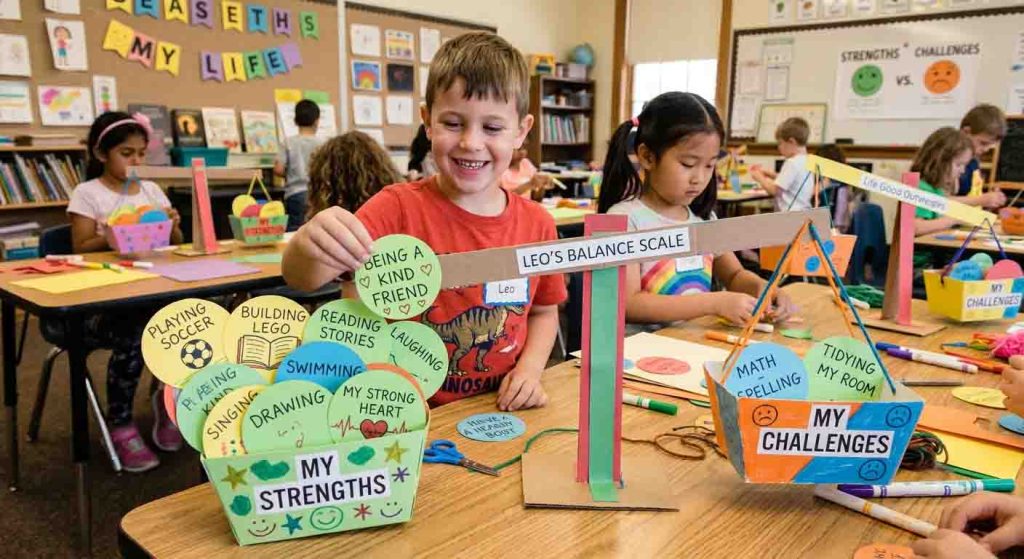
For teachers who wish to conduct a comprehensive craft project, the three-dimensional balancing scale offers a tangible, visual representation of a child’s life. This strategy is highly effective for kinetic learners, as it physically demonstrates how positive attributes outweigh personal difficulties.
Phase one: Preparing the scale templates and card circles
The project begins with the construction of the balancing scale. The teacher provides each pupil with a pre-printed template of a balancing scale on heavy cardstock, which the children cut out and assemble using glue sticks.
Once the scale structure is complete, the teacher distributes two sets of paper circles. Green circles are labelled as “My Strengths and Blessings”, while yellow circles are designated as “My Goals for Growth”. The physical construction of the scale sets a purposeful, creative tone for the classroom.
Phase two: Distributing the prompt circles
In this phase, the teacher displays a list of pre-defined phrases on the board, covering academic subjects, physical attributes, and social talents. The pupils select phrases that match their personal lives and write them onto the coloured paper circles.
The green circles receive phrases representing positive qualities, such as reading stories, playing football, being a kind friend, singing, or having a healthy body. The yellow circles are filled with phrases representing areas where the pupils struggle, such as spelling, punctuation, mathematics, or tidying their room. This separation of colours helps the children visually categorise their attributes before assembly.
Phase three: Achieving the visual weight balance
The final phase involves pasting the completed circles onto the pans of the paper scale. The teacher instructs the pupils to paste their green circles onto the left pan and their yellow circles onto the right pan. To ensure a positive outcome, the educator mandates that each pupil must identify at least five strengths and blessings, while limiting their growth goals to a maximum of three.
Consequently, when the assembly is complete, the green side of the scale is physically larger and more filled than the yellow side. This visual imbalance serves as proof to the child that their strengths and bodily fortunes outweigh their current struggles.
Teacher instructions: How to use this resource
To prepare this self-reflection exercise, write only the bolded words or phrases on your classroom whiteboard (for the two-column table) or print them directly onto the circle cards (for the three-dimensional balancing scale).
The full sentences following each bold phrase are designed as verbal explanations to be read aloud by you. These sentences clarify the real-world meaning of each card to your pupils but should not be written in their tables or on their physical cards. This method keeps the written activity visually clean, highly readable, and perfectly accessible for children seven years and older.
Category one: Academic and cognitive growth
Reading Aloud: Reading chapter books aloud with expression and confidence.
Neat Handwriting: Writing neat capital and lowercase letters that sit on the line.
Spelling Words: Spelling tricky high-frequency words without looking at a word mat.
Using Punctuation: Using full stops and capital letters in every sentence.
Storytelling: Telling imaginative stories with a clear beginning, middle, and end.
Maths Games: Solving addition and subtraction equations during mental maths games.
Science Lessons: Remembering the names of different animals and their natural habitats in science lessons.
Geography Maps: Naming the continents and oceans on a world map in social studies.
Speaking Spanish: Speaking clearly and using new words during Spanish vocabulary practice.
Staying Focused: Concentrating quietly on a task without becoming distracted by classroom noise.
Asking Questions: Asking thoughtful questions when learning about historical events.
Good Listening: Listening carefully to instructions the first time they are spoken.
Group Work: Sharing ideas confidently during group discussions and partner work.
Staying Resilient: Trying again immediately when a school task feels difficult.
Desk Organisation: Keeping a clean and organised desk or tray for schoolbooks.
Category two: Physical health, senses, and bodily fortunes
Healthy Breathing: Having strong, healthy lungs that allow for deep, easy breathing.
Sharp Eyesight: Having sharp eyesight to read books and see distant objects clearly.
Good Hearing: Having excellent hearing to enjoy music, stories, and the voices of friends.
Strong Heart: Having a strong, steady heart that beats reliably during exercise.
Strong Legs: Having legs that are strong enough to jump high and climb play equipment.
Clever Hands: Having steady hands that can thread beads, cut paper, and tie knots.
Great Sleep: Falling asleep easily and waking up feeling refreshed and full of energy.
Strong Immunity: Having a strong immune system that helps the body fight off common colds.
Good Flexibility: Feeling flexible and being able to bend, stretch, and touch the toes.
Healthy Teeth: Having healthy teeth and gums for chewing food comfortably.
Good Balance: Having a reliable sense of balance when walking along a narrow garden wall.
Physical Stamina: Having the physical stamina to walk or hike with family without tiring quickly.
Quick Reflexes: Possessing quick reflexes to catch a falling object or react to a game.
Fast Healing: Having a body that heals quickly after getting a small scrape or bruise.
Healthy Eating: Enjoying the taste and texture of a wide variety of healthy foods.
Category three: Creative talents and expressive arts
Drawing Pictures: Drawing realistic animals, vehicles, or nature scenes with coloured pencils.
Painting Art: Painting with bright colours and keeping the paint within the borders.
Lego Building: Building complex structures, vehicles, or cities using Lego blocks.
Keeping Rhythm: Keeping a steady rhythm when clapping or playing a percussion instrument.
Singing Songs: Singing songs in tune and remembering all the lyrics.
Playing Music: Playing simple melodies on the recorder, keyboard, or ukulele.
Clay Sculpting: Creating beautiful shapes and models using clay or playdough.
Inventing Games: Inventing fun games with unique rules for friends to play at break-time.
Role-play Acting: Acting out characters and changing the voice during classroom role-play.
Dancing Beat: Dancing to a rhythm and coordinating movements with a musical beat.
Paper Crafts: Making decorative paper crafts using folding, cutting, and pasting techniques.
Writing Poetry: Writing creative poems that rhyme or follow a specific pattern.
Poster Design: Designing colourful posters to explain classroom rules or topics.
Telling Jokes: Telling funny jokes that make classmates and family members laugh.
Tidying Toys: Arranging toys or bedroom items in a visually pleasing and creative way.
Category four: Social, emotional, and character strengths
Sharing Things: Sharing toys and learning materials willingly without being asked by an adult.
Showing Empathy: Helping classmates who are feeling sad, lonely, or hurt on the playground.
Patient Listening: Listening patiently while a friend is speaking without interrupting them.
Being Polite: Saying please and thank you to show appreciation to others.
Forgiving Friends: Forgiving friends quickly after a disagreement or misunderstanding.
Being Inclusive: Welcoming new pupils to the school and inviting them to join play groups.
Being Honest: Telling the truth even when making a mistake or facing a difficult situation.
Self-Control: Waiting patiently in queues or waiting for a turn during class activities.
Showing Respect: Showing respect to teachers, school staff, and classmates at all times.
Being Kind: Noticing when someone is left out of a game and inviting them to play.
Staying Calm: Calming down quickly when feeling angry, frustrated, or disappointed.
Cooperating Well: Cooperating with group members to complete a shared task peacefully.
Encouraging Others: Offering kind words of encouragement to classmates who are struggling.
Being Loyal: Being a loyal companion who keeps promises made to friends.
Being Curious: Showing curiosity about the lives, cultures, and feelings of other people.
Category five: Practical life skills and daily responsibilities
Tidying Up: Tidying up toys, books, and learning materials after finishing an activity.
Dressing Myself: Getting dressed independently in the morning, including fastening buttons.
Packing Bags: Packing a school bag with all the necessary books, pencils, and lunchboxes.
Brushing Teeth: Brushing teeth thoroughly twice a day without needing a reminder.
Pet Care: Caring for family pets by offering food, water, or gentle attention.
Kitchen Help: Helping parents prepare meals by washing vegetables or setting the dinner table.
Clean Room: Keeping bedroom floors clear of clothes and shoes.
Homework Routine: Remembering to bring completed homework back to school on the correct day.
Washing Hands: Washing hands thoroughly with soap before eating and after using the toilet.
Clearing Dishes: Clearing the table and carrying dirty dishes to the kitchen sink.
Gardening Help: Watering houseplants or helping to pull weeds in the garden.
Tying Shoelaces: Fastening shoe laces securely in a double knot.
Hanging Coats: Hanging up school coats and placing bags in the designated cloakroom area.
Carrying Bags: Helping to carry light shopping bags from the car into the house.
Organising Trips: Showing independence when organising personal belongings for weekend trips.
Teacher guidance for supporting diverse student needs
To maximise the efficacy of this self-esteem exercise, educators must remain sensitive to the diverse backgrounds and physical abilities of the pupils in their care. The classroom often contains children with vastly different life circumstances, and the teacher must actively manage the discussion to ensure that no child feels excluded or discouraged.
When addressing physical health, the teacher should approach the topic with care, acknowledging that some children in the room may face permanent physical limitations, such as needing a wheelchair or managing chronic illnesses. In these instances, the teacher should guide the discussion toward the concept of personal adaptation.
The educator can highlight how a student who cannot run may possess incredible artistic skills, or how a pupil with hearing loss might have an exceptional eye for detail. This framing teaches healthy children to appreciate their functional bodies, while simultaneously empowering students with disabilities to find pride in their unique adaptations.
Furthermore, when discussing academic struggles in areas like grammar, mathematics, or Spanish, the teacher must consistently promote a growth mindset. Pupils should understand that cognitive skills are highly changeable. By framing the yellow circles or the challenge column as “goals for future growth”, teachers remove the stigma of failure and replace it with a sense of forward momentum.
Conclusion
Whether implemented as a rapid two-column table or as an involved three-dimensional balancing scale project, this classroom self-esteem exercise provides a valuable framework for pupils aged seven years and older. By prompting students to evaluate their academic performance alongside their creative talents and physical health, the activity prevents children from defining their self-worth solely by their academic weaknesses.
See also: