 Study Zone Institute Teaching and learning made easy




Science experiments for kids can be safe, affordable, educational and highly effective when built around common household items and clear scientific principles. This guide presents age-appropriate experiments for children aged 5 to 12 using materials already found in many homes.
Parents, teachers and carers increasingly search for hands-on STEM activities that develop curiosity, observation skills and confidence without expensive kits. This article explains how each activity works, what children learn, and how to adapt experiments for different ages.
It also supports home learning, classroom enrichment and holiday activities across international audiences. The experiments below are selected for safety, simplicity and educational value while aligning with core elementary science concepts.
Key Takeaways
- Simple household items can teach real scientific principles.
- Hands-on learning improves memory and engagement.
- Experiments can be adapted for ages 5 to 12.
- Safety, supervision and discussion are essential.
- Science learning starts with curiosity and observation.
Science does not need a laboratory to become exciting. Some of the most effective early learning experiences happen at a kitchen table, on a patio, or in a classroom using cups, water, paper, food colouring and everyday objects.
Children naturally ask questions about how things move, mix, grow, float and change. Practical activities help transform those questions into understanding. That is why Science Experiments for Kids remain one of the strongest tools for introducing biology, chemistry, physics and environmental science.
For children aged 5 to 12, experiments should balance fun with genuine learning. Younger children benefit from colourful reactions, movement and visible changes. Older children can begin measuring, predicting results, recording observations and understanding variables. When adults guide the process with questions such as “What do you think will happen?” and “Why did that change?”, children begin thinking like scientists.
Why home science matters
Elementary science builds foundational skills far beyond the subject itself. Children learn to observe patterns, compare results, test ideas and communicate findings. These are the roots of critical thinking. Science activities also support literacy because children describe what they see, and numeracy because they count, estimate and measure.
Using household items makes science inclusive and accessible. Families and schools do not need costly equipment. Vinegar, baking soda, paper towels, balloons, salt, ice and soap can become powerful teaching tools. This practical approach is valuable in the USA, Canada, UK, India, Trinidad and Tobago, Guyana, Barbados, Jamaica and many other regions where parents seek affordable educational resources.
Safety first for science experiments for kids
Adult supervision is important, especially for younger children. Use non-toxic materials, avoid flames, and keep small items away from children who may swallow them. Protect surfaces where needed and wash hands after activities. Encourage children to wear old clothing or aprons for messy experiments. Safety habits are part of scientific discipline.
Experiment 1: Baking Soda Volcano
This classic activity remains popular because it demonstrates chemical reactions clearly.
You need baking soda, vinegar, a cup or bottle, dish soap and optional food colouring. Place the cup on a tray. Add a few spoonfuls of baking soda, a drop of dish soap and colouring. Pour in vinegar.
The mixture foams and erupts because baking soda, a base, reacts with vinegar, an acid, producing carbon dioxide gas. The gas forms bubbles that force liquid upward.
Children learn about reactions, gases and cause and effect. Older children can test whether changing the amount of vinegar alters the eruption size.
Experiment 2: Rainbow Milk
This visually striking activity introduces surface tension and molecular movement.
You need milk, food colouring, a shallow plate and dish soap. Pour milk into the plate. Add drops of colouring around the surface. Dip a cotton bud into dish soap and touch the milk.
The colours rapidly move and swirl. Soap breaks the surface tension of the milk and interacts with fat molecules, causing motion.
Children learn that liquids have invisible forces. Ask them to observe how the colours change over time.
Experiment 3: Floating Egg
This easy experiment teaches density.
You need two glasses, water, salt and an egg. Fill both glasses with water. Add several spoonfuls of salt to one glass and stir well. Place an egg in each glass.
The egg sinks in plain water but floats in salt water because the denser salt solution provides more upward buoyant force.
Children learn why objects float in some liquids and sink in others. Older children can test different salt amounts.
Experiment 4: Growing Crystal Salt Shapes
This experiment introduces evaporation and crystal formation.
You need warm water, salt, a jar, string and a pencil. Dissolve as much salt as possible into warm water. Tie string to a pencil and suspend it into the jar without touching the bottom. Leave for several days.
As water evaporates, salt crystals form on the string.
Children learn that dissolved solids can return to solid form. They also practise patience and observation.
Experiment 5: Homemade Lava Lamp
This activity demonstrates density and immiscible liquids.
You need a clear bottle, water, cooking oil, food colouring and an effervescent tablet. Fill the bottle mostly with oil, then add water. Add colouring, then part of the tablet.
Oil and water separate because they do not mix and have different densities. Gas bubbles from the tablet carry coloured water upward before it sinks again.
Children learn about liquid layers, gas production and movement.
Experiment 6: Paper Towel Walking Water
This experiment teaches capillary action.
You need three cups, water, food colouring and paper towels. Fill two outer cups with coloured water and leave the middle cup empty. Fold paper towels into bridges connecting cups.
Over time, water climbs the towel fibres and moves into the empty cup.
Children learn how water can travel through tiny spaces, similar to how plants move water through stems.
Experiment 7: Balloon Static Electricity
This introduces basic physics.
You need a balloon and small paper pieces. Inflate the balloon and rub it on hair or fabric. Hold it near the paper.
The paper jumps toward the balloon because rubbing transfers electrons, creating static charge.
Children learn that electricity can exist without plugs or batteries.
Experiment 8: Ice and Salt Challenge
This activity shows freezing point depression.
You need ice cubes, salt and two bowls. Put ice in both bowls. Add salt to one bowl.
The salted ice melts faster because salt lowers the freezing point of water.
This principle helps explain why salt is spread on icy roads in cold countries.
Experiment 9: Seed Germination in a Bag
This introduces plant biology.
You need a clear plastic bag, damp paper towel and bean seeds. Place seeds inside against the towel and tape the bag to a bright window.
Over several days roots and shoots appear.
Children learn that seeds need moisture, warmth and suitable conditions to germinate. They can measure growth daily.
Experiment 10: Sink or Float Test Lab
This flexible activity builds prediction skills.
Fill a basin with water and gather safe objects such as spoon, cork, coin, leaf, plastic lid and sponge. Ask children to predict which items will sink or float before testing.
Children learn that size alone does not determine floating. Material and density matter more.
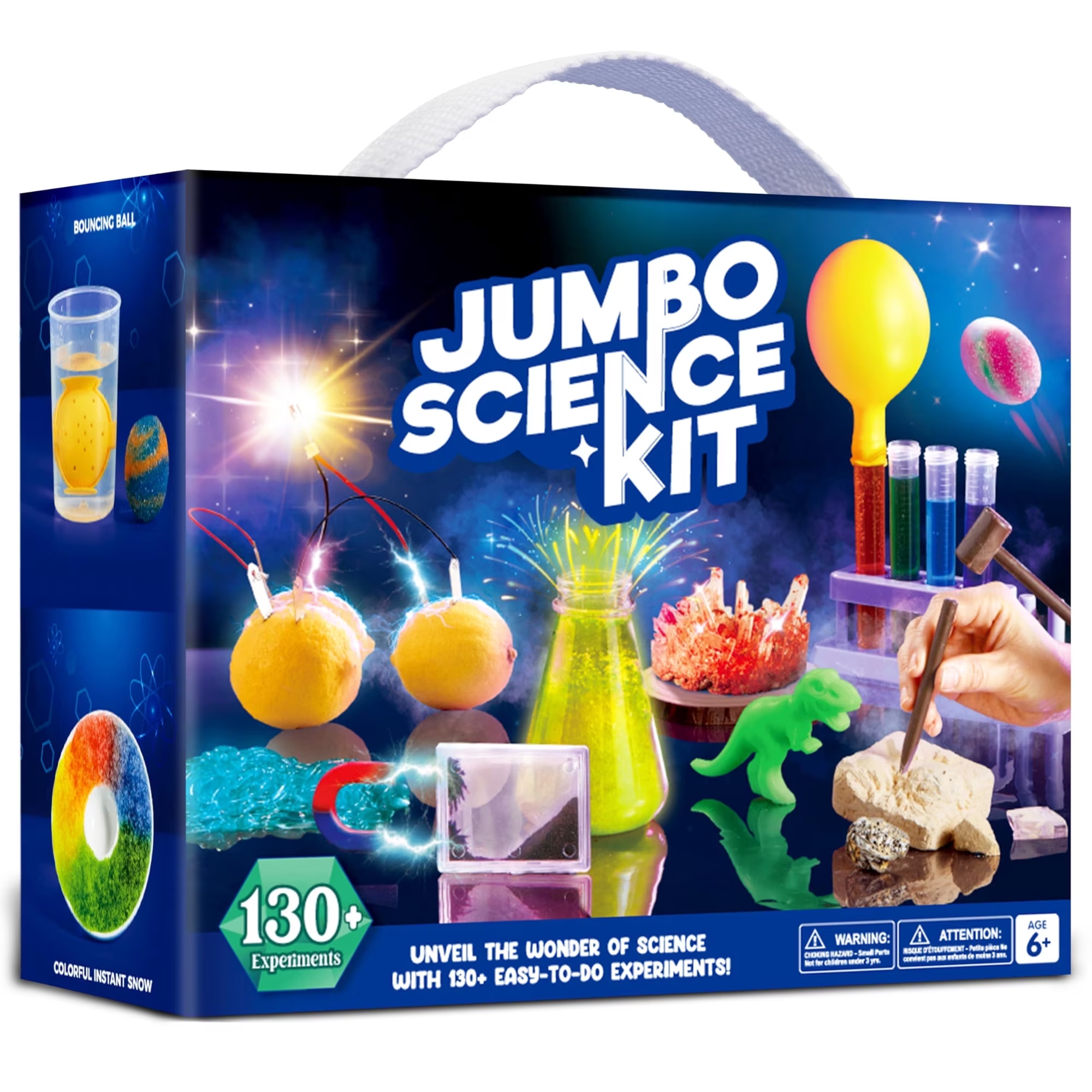
How to make experiments educational
Many adults focus on the exciting moment, but the learning often comes before and after. Ask children to form a hypothesis. This means making an educated prediction. During the experiment, encourage careful observation. Afterwards, discuss results.
Useful questions include:
What happened first?
What changed?
Why do you think that happened?
What would happen if we changed one thing?
Was your prediction correct?
This process teaches the scientific method in a natural way.
Best science experiments for different ages
Children aged 5 to 7 often enjoy colour, bubbles, floating and movement. Good choices include rainbow milk, volcanoes and sink-or-float tests.
Children aged 8 to 10 can begin measuring ingredients, timing reactions and writing notes. Crystal growth, walking water and seed germination work well.
Children aged 11 to 12 can explore variables, repeat tests, graph results and explain mechanisms. They are ready for more structured investigation.
Relevance of science experiments for kids
Science learning is universal. Whether a child lives in New York, London, Mumbai, Port of Spain, Georgetown, Bridgetown or Kingston, curiosity works the same way. Household science activities cross cultures because they use common materials and shared human experiences such as cooking, weather, water, plants and motion.
This makes science experiments for kids ideal for homeschooling, after-school clubs, primary schools, tutoring centres and family weekends worldwide.
Learning benefits for parents and teachers
Parents and teachers frequently search for practical educational activities online. They want low-cost, low-preparation and high-value resources. Articles like this succeed because they answer direct search intent clearly. Readers seek experiments that are safe, simple and genuinely educational.
For teachers, these experiments support classroom objectives in states, provinces and national curricula. For parents, they provide screen-free learning time and stronger family engagement.
Final thoughts
Science begins when a child notices something surprising and asks why. A fizzing cup, a floating egg or a sprouting seed can become the start of lifelong curiosity. The strongest Science Experiments for Kids are not always the most complex. They are the ones that connect everyday materials with clear scientific ideas.
Using household items removes barriers and allows families and educators to focus on exploration rather than expense. For children aged 5 to 12, these simple activities build confidence, reasoning and excitement about the world. That combination is the true foundation of science education.
FAQ: Science experiments for kids
What are the easiest science experiments for kids?
Baking soda volcanoes, floating eggs, sink-or-float tests and rainbow milk are among the easiest.
Are household science experiments safe?
Most are safe with adult supervision and non-toxic materials.
What age should children start science experiments?
Children can begin simple observation-based activities from age 5 and progress in complexity as they grow.
Do science experiments help school performance?
Yes. They improve critical thinking, vocabulary, observation and problem-solving skills.
Do I need expensive science kits?
No. Many effective experiments use items already found at home.
When you buy something through our retail links, we may earn commission and the retailer may receive certain auditable data for accounting purposes.
- How do debits and credits work? A beginner’s guide to accounting
- Mastering subject verb agreement: Interactive teaching strategies for diverse learners
- Game world and real world: Helping children appreciate life and build genuine social connections
- Why older children struggle with basic spatial concepts and how multisensory learning can fix it
- Master homophones and homographs: Easy strategies for struggling learners
See also:
The periodic table made simple: Learn chemistry basics with interesting techniques
Teach science without a lab: Fun at-home activities that spark curiosity
Become a science teacher: A rewarding career path
Veterinary medicine: A rewarding career for animal lovers
Science resources: Ignite student curiosity with engaging tools
What is good health? Boost your brain and body with these tips
Electricity: Unravelling the fundamentals
Friction: The imperceptible force paving our path
Gravity: A universal force that affects every aspect of our lives
Exploring electricity and magnetism: Unveiling the power behind your gadgets
Exploring life’s diversity: A look at major groups of organisms
Physics: Examples of complex theories and equations in everyday life
Chemistry fundamentals: Exploring matter, particles, and changing states
Major groups of organisms in over 8 million types
7 Characteristics of living things
@studyzoneinstituteltd
Discover more from Study Zone Institute
Subscribe to get the latest posts sent to your email.



